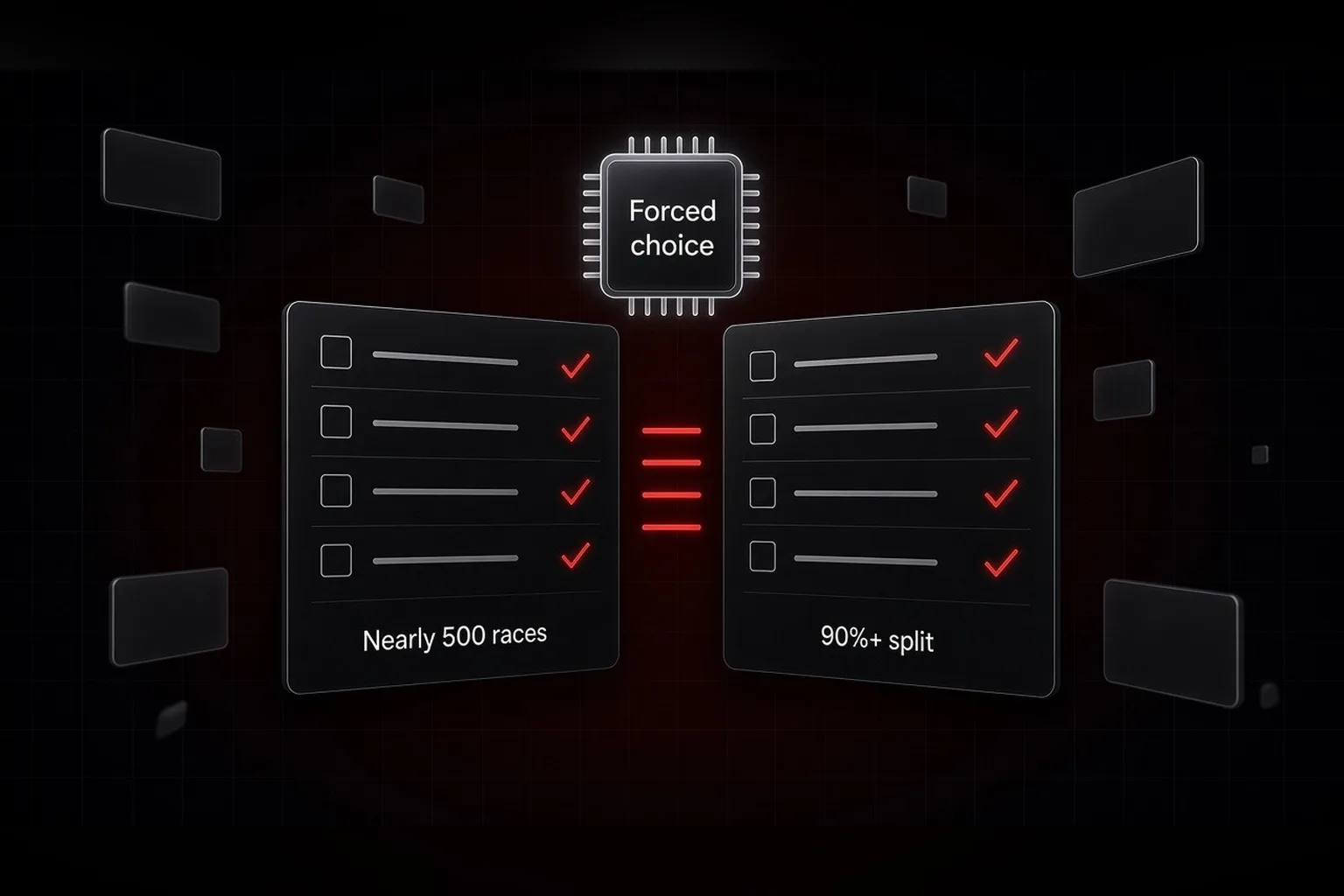
Grok and OpenAI’s GPT reportedly recommended different candidates in more than 90% of nearly 500 election races. Grok overwhelmingly selected Republicans, while GPT favored Democrats, according to a study reported by TechCrunch.
The two prominent AI models received the same basic kind of task but split along opposing party lines. The result does not establish how either system would respond in an ordinary political conversation. It shows that requiring one recommendation can expose sharp differences between models.
According to the available account, researchers forced each model to choose between candidates across nearly 500 election contests, then compared the selections. The supplied summary does not identify the exact prompts, races, model versions or scoring procedure. Claims about how the systems reached their answers would therefore go beyond the reported facts.
The central finding is the disagreement rate. Grok and GPT selected different candidates in more than 90% of the tested races. Grok’s choices leaned overwhelmingly Republican, while GPT’s leaned Democratic. The stored account did not provide exact partisan percentages for either model.
A forced-choice test is closer to making a compass point north or south than asking it to draw a complete map. It can show the direction of a model’s output under pressure, but it cannot explain the route behind the answer. The models might respond differently if allowed to decline, compare policy positions or express uncertainty.
The available summary also does not include limitations acknowledged by the study’s authors. It remains unresolved whether researchers repeated prompts, changed their wording, controlled the order of candidate names or tested multiple versions of each model. Those details could determine whether the findings reflect stable model behavior or sensitivity to the test setup.
The study is not proof that every Grok response is Republican or every GPT response is Democratic. Its narrower finding applies to recommendations made under a forced choice. That constraint matters when products convert model output into rankings, endorsements or voter guidance, because users may receive one answer without seeing how strongly the prompt shaped it.
Builders need to test the interaction users will actually encounter. A general safety evaluation may not detect patterns that emerge only when a model must choose one person, product or policy. Political testing should record the prompt, model version, refusal options and repeated results, then compare outcomes across parties and races.
Teams deploying AI for election information now have a concrete release check: run and document a balanced forced-choice evaluation before presenting model-generated candidate recommendations to users.
This article is not legal advice.