Meta introduced Muse Ember on November 9, 2026, describing it as its smallest and most efficient model, built for the work agents repeat all day: tool calls, coding subtasks, routing, extraction and long document parsing.
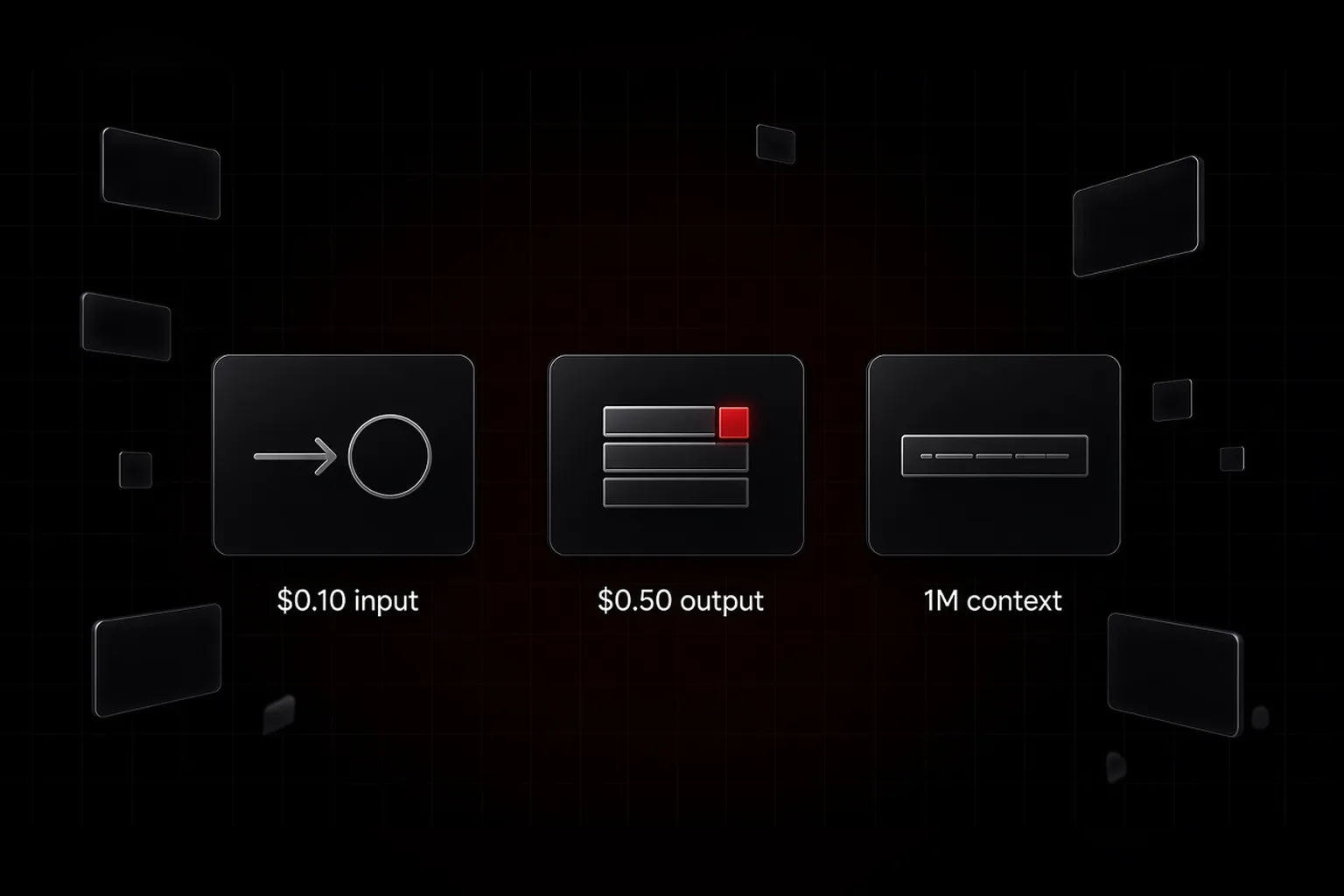
The model is available on Muse Code and the Meta Model API as muse-ember-1.0, and Meta says Muse Ember, Muse Spark and Muse Wonder are now available on Google Cloud and Oracle Cloud. The list price for prompts up to 200K tokens is $0.10 per million input tokens, $0.004 per million cached input tokens and $0.50 per million output tokens. For longer prompts the price is $0.30, $0.012 and $1.50. The context window is 1 million tokens, with up to 512K output tokens. Muse Ember supports the Responses API.
Meta places Ember on the efficiency frontier of the Artificial Analysis leaderboard and says it delivers more intelligence per dollar than Claude Haiku 5.5 or GPT-6 Luna at any reasoning setting, matching Haiku's best score at about one third of the cost. It cites a cost of about $0.14 per Artificial Analysis task at list pricing. These comparisons use Artificial Analysis Intelligence Index v5 figures as published on November 9, 2026, together with Meta's own evaluations, and should be read as Meta's account.
Among the numbers Meta reports at max reasoning: 37.8% on AutomationBench-AA, 61.6% on Agents' Last Exam (Meta's Linux subset), 40.9% on Terminal-Bench 4.0 in Ember's best published harness, and 36 on the Artificial Analysis Index, tied with Haiku 5.5 at max and ahead of GPT-6 Luna's 28. On FrontierCode 2.0-AA, Haiku 5.5 leads at 34.9% against Ember's 27.2%.
Meta says it evaluated Ember under its Superintelligence Scaling Framework, including chemical and biological, cybersecurity and loss-of-control risks, and that Ember remained below the framework's high-risk thresholds. Ember is the first specialised model Meta says it trained using Muse Wonder Full. The company positions Wonder for the hardest problems, Spark for coding and agent workflows, and Ember for repeatable tasks at scale.
Why this matters
The list price is low enough that teams can run a dedicated worker model beside a larger planner. The 200K cutoff matters: prompts longer than that triple the input and output prices. Benchmark leads are Meta's, and on FrontierCode 2.0 Ember is not first, so a bake-off on the actual subtasks still decides whether $0.10 and $0.50 are the right pair.
Sources: Meta announcement.
This article is not legal advice.