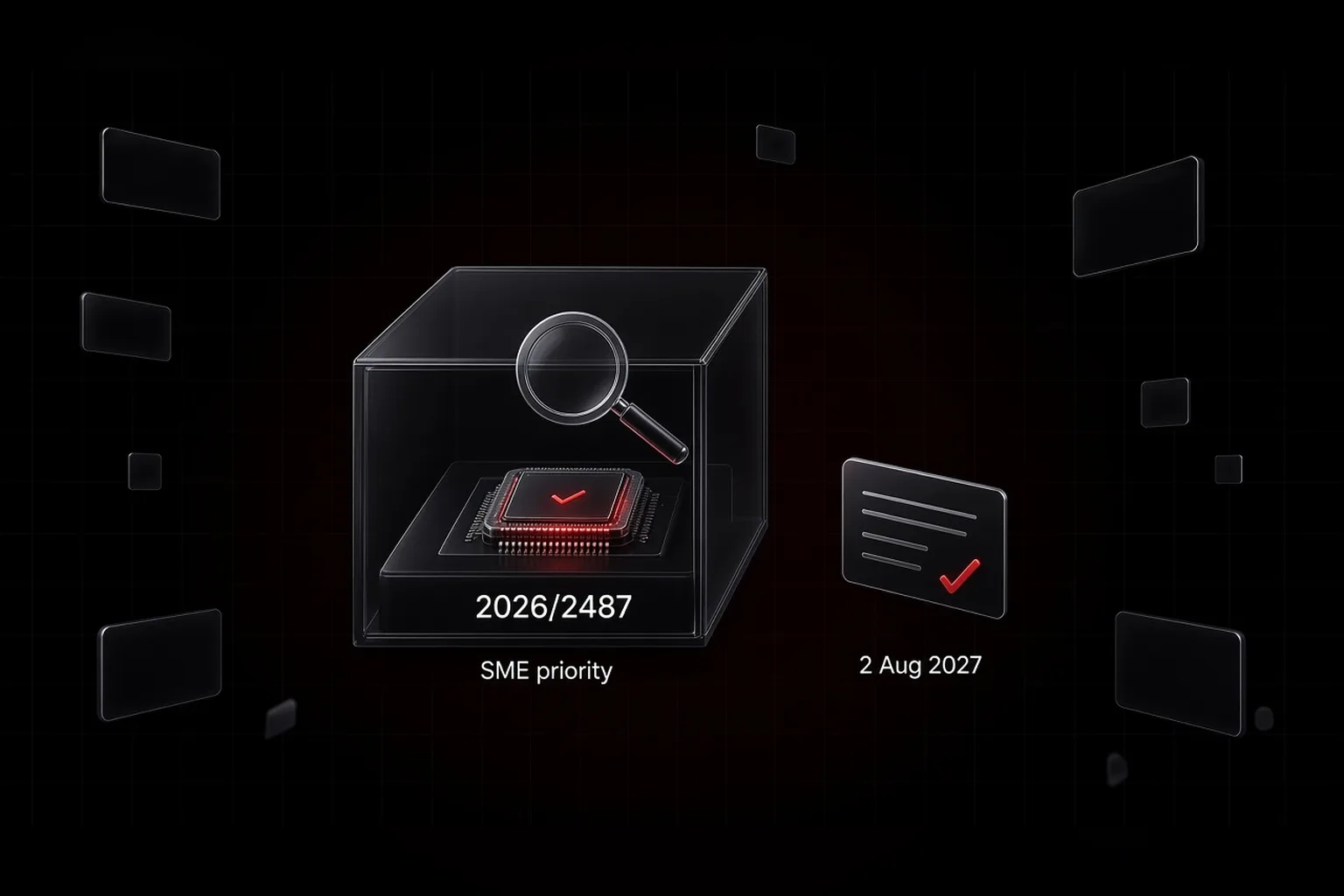
The European Commission adopted Implementing Regulation (EU) 2026/2487 on 10 November 2026, and it was published in the Official Journal on 11 November. It sets common rules for AI regulatory sandboxes, the supervised settings where companies can develop and test AI systems with a national authority before putting them on the market. It enters into force on 1 December 2026.
Why there are rules now
Article 57 of the AI Act requires each member state to have at least one AI regulatory sandbox in operation by 2 August 2027. The regulation sets one set of procedures so that a sandbox in Madrid and one in Sofia work in the same way.
How a sandbox works
Small and medium sized companies and start-ups get priority access, and participation is free for them, apart from exceptional costs. Authorities must decide on a complete application within three months. Each project agrees a sandbox plan with its authority, setting out objectives, conditions, timeline and how risks are handled. The authority can suspend testing if it finds a risk to health, safety or fundamental rights that cannot be mitigated.
How it ends
At the end of testing, the authority issues an exit report within 45 working days. The report is recognised across the EU and can support later conformity assessment, but it is not a declaration of conformity, and taking part in a sandbox is not authorisation to put a system on the market.
Spain ran an early pilot that tested 12 high risk AI systems from six sectors and produced 16 practical guides, according to the Spanish government.
Why this matters
For a company building a high risk system, for example credit scoring, a sandbox offers structured contact with the supervisor before the high risk rules apply. The exit report will not replace the conformity work, so it is worth planning the sandbox plan so its outputs feed straight into the technical documentation.
Sources: Implementing Regulation (EU) 2026/2487 in the Official Journal, note from the Spanish government portal (Spanish).
This article is not legal advice.