NVIDIA introduced Nemotron for Science on 16 November 2026. It is a package for building AI agents for scientific work, based on the open Nemotron 3.5 Super VL model, with scientific evaluations, a new open chemistry dataset and post-training recipes.
The dataset
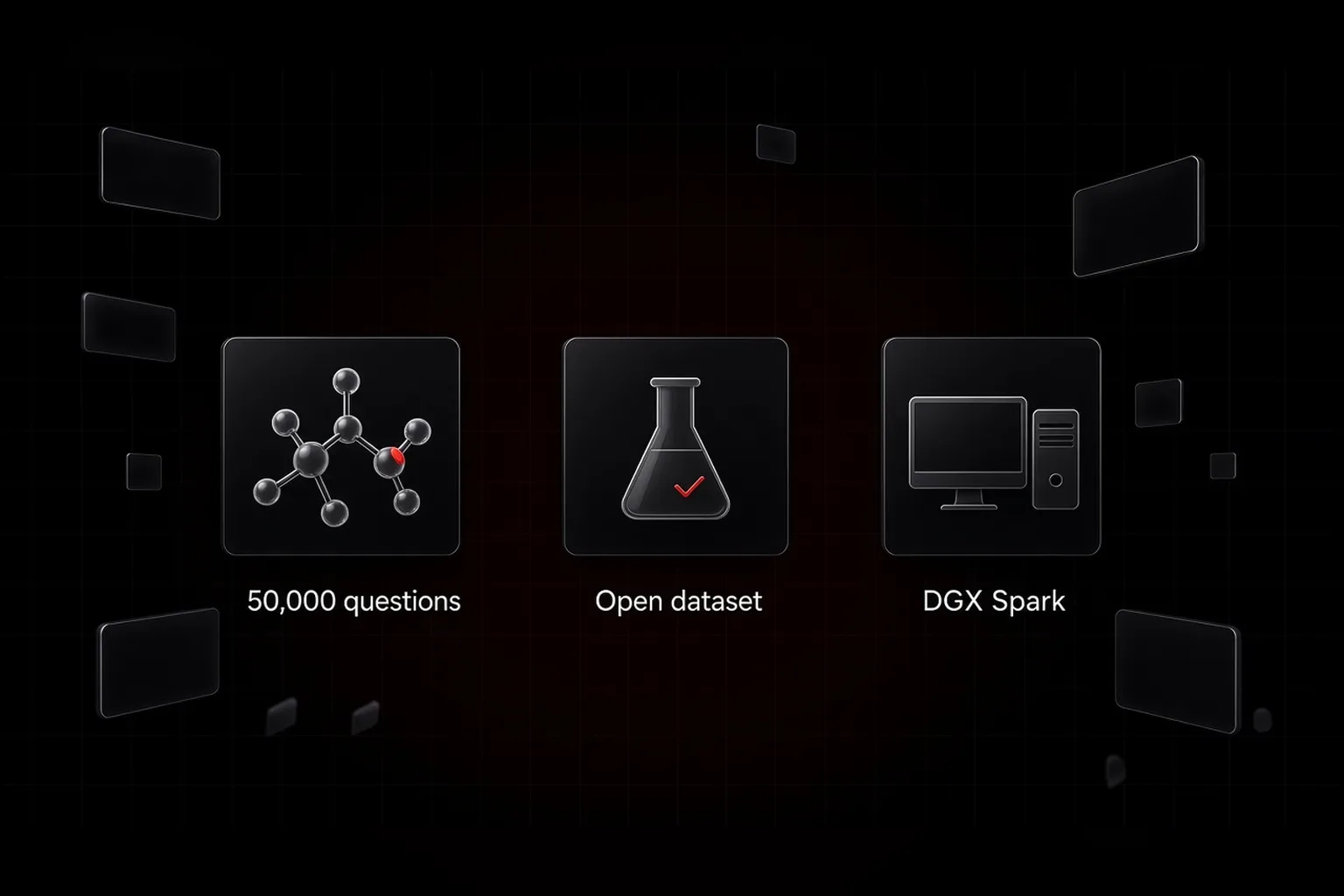
LitmusBench v0.2 holds nearly 50,000 questions for training and testing language models on chemistry reasoning. It draws on molecular properties and experimental drug discovery data, such as how soluble a molecule is and how the human body processes it.
Reported results
NVIDIA cites results from partners who post-trained the model. Terray Therapeutics says its version recovered about 76% of annotated reactions on the RxnScribe test. Lila Sciences says post-training with lab feedback nearly doubled accuracy for making quantum dots to 61%, against 54% for GPT-6 Astra, at 10 to 20 times lower inference cost. KTH Royal Institute of Technology built an agent that fixed 81% of broken GROMACS molecular dynamics test cases in one overnight run on a single DGX Spark.
Argonne National Laboratory, Jülich Supercomputing Centre and RIKEN are also integrating Nemotron into research systems. These figures come from NVIDIA and its partners, not from an independent test.
Availability
Nemotron 3.5 Super VL and LitmusBench v0.2 are available now on Hugging Face. NVIDIA says the model is optimised to run locally on a DGX Spark with 128 GB of memory.
Why this matters
An open model that runs on a desktop machine lets a lab keep its data on its own hardware and still post-train for its field. The partner results show what targeted post-training can do, and each team will need its own test set to know if it holds for their work.
Sources: NVIDIA announcement.
This article is not legal advice.