
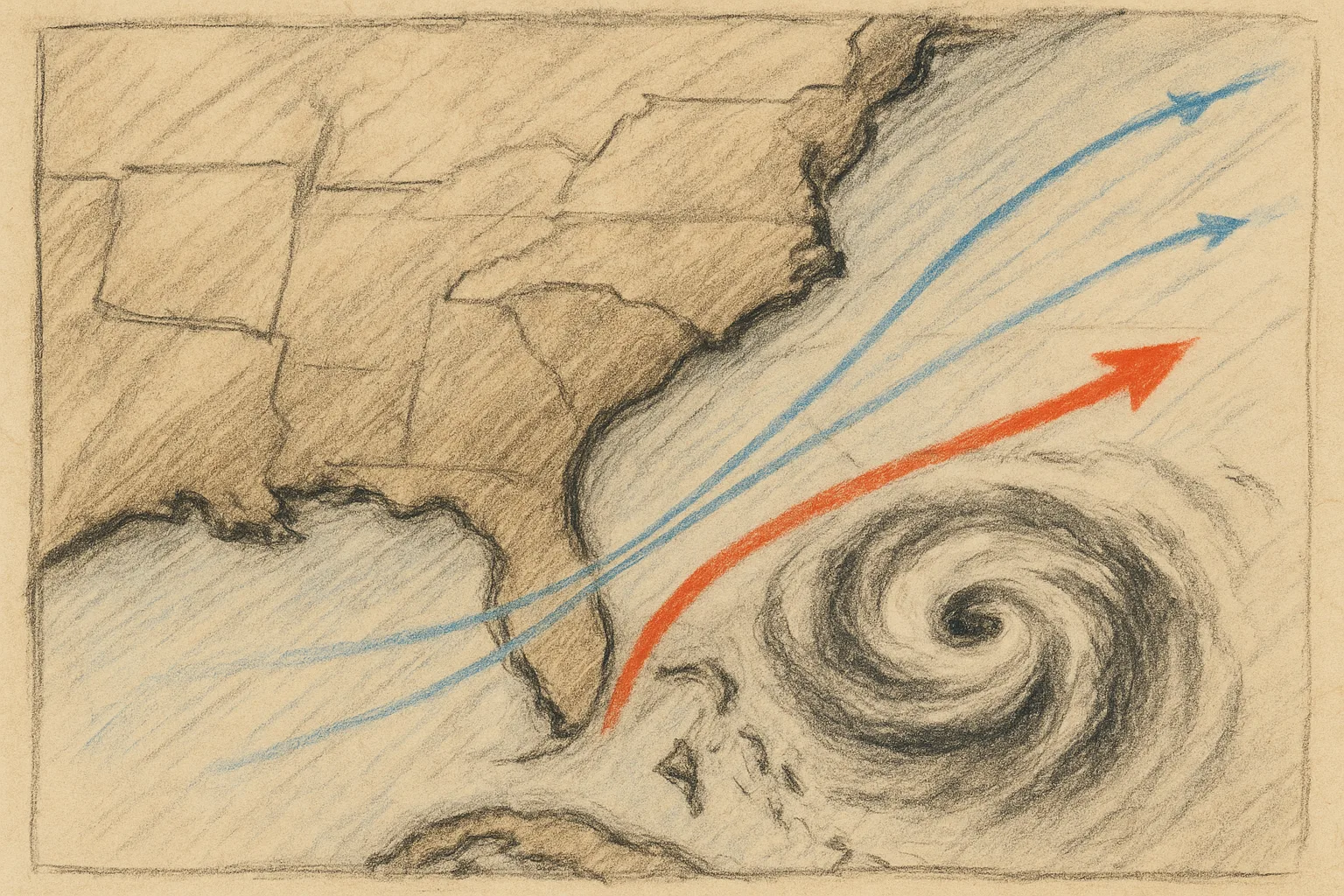
WeatherNext matched at three days the tropical-cyclone forecast accuracy earlier models reached at two. The benchmark comes from the WeatherNext tropical-cyclone research published in Nature and is summarized in Ars Technica’s report. Ars also reports that hurricane forecasting has historically needed about a decade of work to gain one day of forecast skill.
The strategic value is not simply a higher score. A forecast made three days ahead gives forecasters more time to compare outcomes and communicate risk than one that reaches similar accuracy only two days ahead. The benchmark therefore measures potential decision time, not just model performance.
Hurricane Melissa provided a live example in October 2025. Five days before landfall, WeatherNext assigned an 80% probability that Melissa would reach Jamaica as a Category 5 hurricane, according to Ars Technica. The report says Melissa later caused flooding and landslides across the country and that the US National Hurricane Center used WeatherNext as one input when issuing earlier warnings.
That example demonstrates practical use, not broad operational validation. One storm can show that a forecast reached working forecasters in time to inform decisions. It cannot show that WeatherNext’s retrospective advantage will persist across future storms, regions or seasons.
Hurricane forecasting operates at two scales. A storm’s route depends on large weather systems such as prevailing winds and cold fronts, while its intensity depends on local atmospheric and ocean conditions. Earlier AI systems handled tracks better than intensity because global models lacked enough local detail, according to the Ars report on the Nature research.
That split explains why intensity is the harder test. Predicting where a storm may travel is not enough when emergency decisions also depend on how strong it may become. WeatherNext matters if it can narrow that gap without requiring the fine-grained inputs researchers expected intensity forecasting to need.
DeepMind and Google Research addressed the shortage of cyclone examples by training WeatherNext with both general weather data and cyclone data. Rather than issuing one deterministic answer, the model generates a distribution of possible tracks and intensities, as described in the Nature research and Ars Technica’s coverage.
This design shifts the model’s role. It is not selecting one future and asking forecasters to trust it. It is mapping a range of plausible futures so forecasters can inspect both the central outcome and the dangerous edges.
During the 2025 season, WeatherNext generated 50 scenarios for each storm. It now generates 1,000, according to Ars Technica. The researchers told Ars that the numerical models available to them could not produce that many scenarios with the computing power they had.
More scenarios do not automatically make a forecast better. Their value is coverage: a larger set can reveal outcomes that a smaller sample may omit. The trade-off is that forecasters must still decide which branches deserve attention and how much confidence to place in their distribution.
Think of the scenarios as branches on a decision tree. Each starts from a slightly different condition and maps how that difference could grow over several days. Forecasters do not need one branch to be certain. They need the spread to reveal dangerous outcomes that a single forecast might hide.
Melissa illustrates the distinction between useful evidence and conclusive evidence. Ars reports that the National Hurricane Center predicted Category 5 intensity while Melissa was still Category 1 and describes this as an agency first. That is a notable operational example, but the claim comes from the Ars report and does not establish that WeatherNext’s retrospective performance broadly held up in practice.
The stronger conclusion is narrower. WeatherNext produced information that forecasters used during a major storm, and the reported forecast identified a severe outcome early. Repetition across more storms and seasons would be needed before treating that example as evidence of durable operational performance.
The scientific explanation has not caught up with the forecast. Researchers do not fully understand how WeatherNext predicts intensity from relatively coarse atmospheric inputs. It appears to identify useful signals that conventional assumptions suggested would require finer-resolution data, but its internal reasoning remains unclear, according to Ars Technica’s account of the Nature paper.
That uncertainty creates a practical tension. A model can be useful before researchers can fully explain its internal method, but unclear reasoning makes it harder to determine when the system may fail. The extra lead time is valuable only if forecasters understand the limits around it.
The limits are concrete. Extreme cyclones are rare, leaving few relevant training examples. WeatherNext predicts tracks and intensity, not human consequences. Experts must still combine multiple models and translate forecasts into assessments of flooding, wind damage, evacuation needs and resource decisions, as Ars reports.
For builders, WeatherNext makes the case for treating AI as an uncertainty engine rather than an oracle. Its potential value comes from widening the scenario set and extending decision time while forecasters retain judgment. Open-sourcing the WeatherNext models used during hurricane season, as reported by Ars Technica, gives researchers a route to test those limits rather than infer reliability from Melissa alone.
What measurable atmospheric pattern lets WeatherNext infer cyclone intensity from data that current physics-based practice considers too coarse?