
Google introduced the Gemini Decisions API on November 11, 2026, a new endpoint in the Gemini API in Google AI Studio, powered by a model called Gemini Decision 1 (gemini-decision-1).
The API is built for closed-set decisions such as tool selection, policy checks, model routing and context grading. A request can include one multimodal input, across text, images, audio, video and PDFs, of up to 256K tokens, plus up to 1000 independent questions. Google says the model scores the candidate options in a single forward pass and returns probabilities and confidence scores, rather than generating answer text token by token.
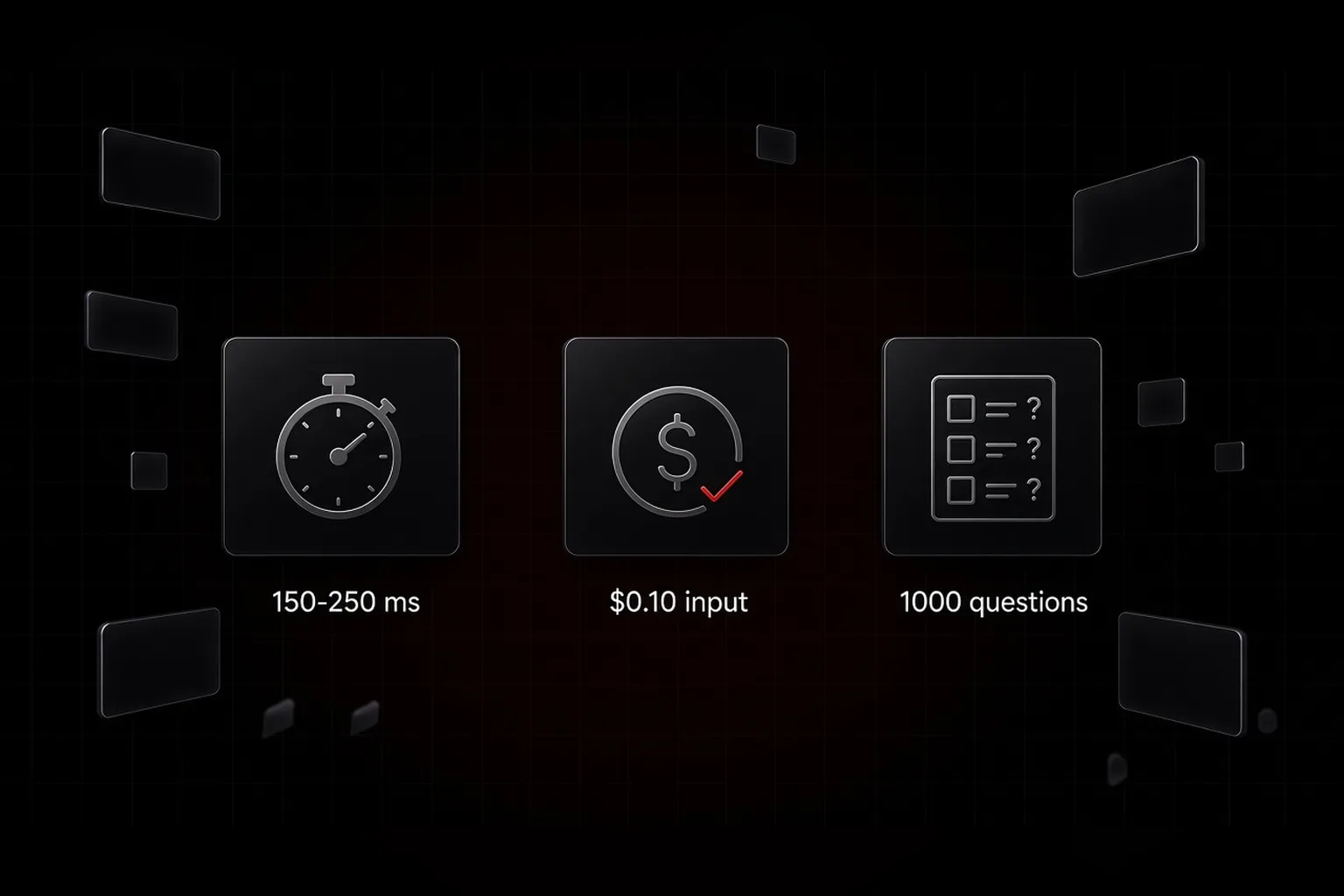
End-to-end latency is given as 150-250 ms, with 50-100 ms of model compute as a median, for multimodal inputs and contexts up to 16K tokens, and Google says that time stays nearly flat from 1 to 100 questions per request. The price is $0.10 per million input tokens and $0 for output tokens. The shared input is billed once per request. Each question adds only its own instruction and criteria tokens. Google says there are no separate audio transcription or OCR charges, and that on its shared benchmark suite the Decisions API is nearly 5 times cheaper than Gemini 3.5 Flash-Lite with the Interactions API. These are Google's figures. A no-cost tier is available in Google AI Studio for prototyping.
Each answer includes a confidence score from 0 to 1, so code can send ambiguous cases to a fallback or a human reviewer. The three question types are noul (yes/no), choice (2 to 255 options) and score (an ordered rubric starting at 0).
Google says its own teams already use the API as a low-latency control plane, including dynamic model routing in Gemini Notebook, which it says serves everyday queries with up to 40% lower latency, plus uses in Stitch, the CC emoji picker and a safety layer for MCP tools in Search. Integrations are rolling out across OpenRouter, LangChain, Vercel, LiteLLM, Pydantic AI, Pipecat, LiveKit and OpenCode, with Google Cloud support still to come.
Why this matters
A lot of agent work is not open-ended writing. It is a yes, a choice or a score, and it has to be fast enough to sit in front of a more expensive model. At $0.10 per million input tokens and no output charge, the cost question moves to how large the shared input is and when a low confidence score should stop an action.
Sources: Google announcement.
This article is not legal advice.